

CQ FD 2026
ARRL Field Day is June 28, 2026. Part One

Every June, when the weather gets nice, amateur radio operators start planning for the last weekend of the month. This annual event, called Field Day, was started by Hiram Percy Maxim in 1933 as a way to encourage hams to practice operating with alternative power sources and improvised stations in case commercial infrastructure failed. Emergency communications (EMCOM) is so ingrained in amateur radio that it remains one of the fundamental justifications for amateur spectrum allocations. Thousands of amateurs volunteer their time, equipment, and skills to assist first responders and the public when normal communications systems fail.
When a Day Lasts All Weekend
Why is it called ‘Field Day’ when we’re talking about the entire weekend? Well, to make the most of it. Ham radio, like aviation, works on Coordinated Universal Time (UTC), which some may call Greenwich Mean Time. Because Field Day spans multiple time zones, the actual clock time matters less than keeping the operating period synchronized nationwide. In the Mountain Time Zone, that means noon Saturday to noon Sunday. But we start setting up the site Friday afternoon so that we’ve got time to work out the kinks and time to run back home (or get the word out to someone en route) for those items that jumped out of the box over the last year.
Once the stations are set up, those of us who camp will usually set up our living quarters. Some more elaborate than others. I’ll be in the minivan again, but a (very) little more built out than last year. More projects than time (or in this case, ability), as usual.
But Field Day is much more than just an emergency exercise. It’s also a fun way to hone your operating skills, learn new skills with lots of help, introduce amateur radio to the general public, and break bread with the club.
During the 24 hour period we, along with other clubs and hundreds of individuals, try to contact as many other stations as we possibly can, all over North America and beyond. Many of the club stations are extremely large, with multiple operators, stations and antenna systems all in use at the same time. Other individuals participate by setting up in their back yard, or even just unplugging the radio from the power supply and connecting up a battery. There are municipal/state/county emergency operations centers (EOC), ARRL state, section and headquarters stations, and even the International Space Station has participated in Field Day.
On Sunday afternoon we tear down the temporary site and leave it looking better than it was before we arrived. Towers, masts, antennas all go back to their respective storage spots in the back of the garage to tangle themselves into knots, until next year when we do it all again.
Site Communications
As Field Day operations have become more computer-driven, the site itself has started looking less like a few radios under pop-up tents and more like a temporary communications campus. This year we’re finally going to do what I’ve wanted to do for about a decade, but never had enough time or motivation. We’re going to have a network for all the tents to use. We set up 3 primary stations based on operating mode: CW (Morse code), SSB (Voice) and Digital (sound card tones). We also set up two auxiliary tents, the “Get On The Air” (GOTA) tent and a VHF tent. In the past we’ve not paid much attention to either, because the rules say that the GOTA tent is worth 100 points and the VHF tent is “free” in that we don’t need to include it in our normal exchange and report. But points is points, and we want to make sure to get the most possible1.
In years past we’ve used a computer logging program called N1MM+. It’s an old workhorse of a program that has gathered hundreds of features that most people never touch. One of these features is to share logs across a LAN as both a real-time way to back up the logs and so each station can keep a real time status of how we’re doing. The logs can also be used to run a dashboard that can show everyone how we’re doing. This year I’ll be leading the buildout of a site-wide WiFi network that will tie all the tents together.
Network Requirements
One of the surprisingly difficult problems at Field Day is keeping all the computers synchronized. In the high country, temperatures range from the upper eighties during the afternoon to below freezing at night. The extreme shift will cause computer real time clocks to drift, leading to problems. N1MM+ wants a fairly accurate real time clock, especially when running in network mode. The digital modes require precision timing to work properly. As clocks drift with temperature they need to get back in line. Luckily I have a stratum 1 NTP time source available, thanks to my Starlink Mini. In years past we’ve had issues with keeping clocks accurate as temperatures changed, so just having accurate time available is probably worth the effort.
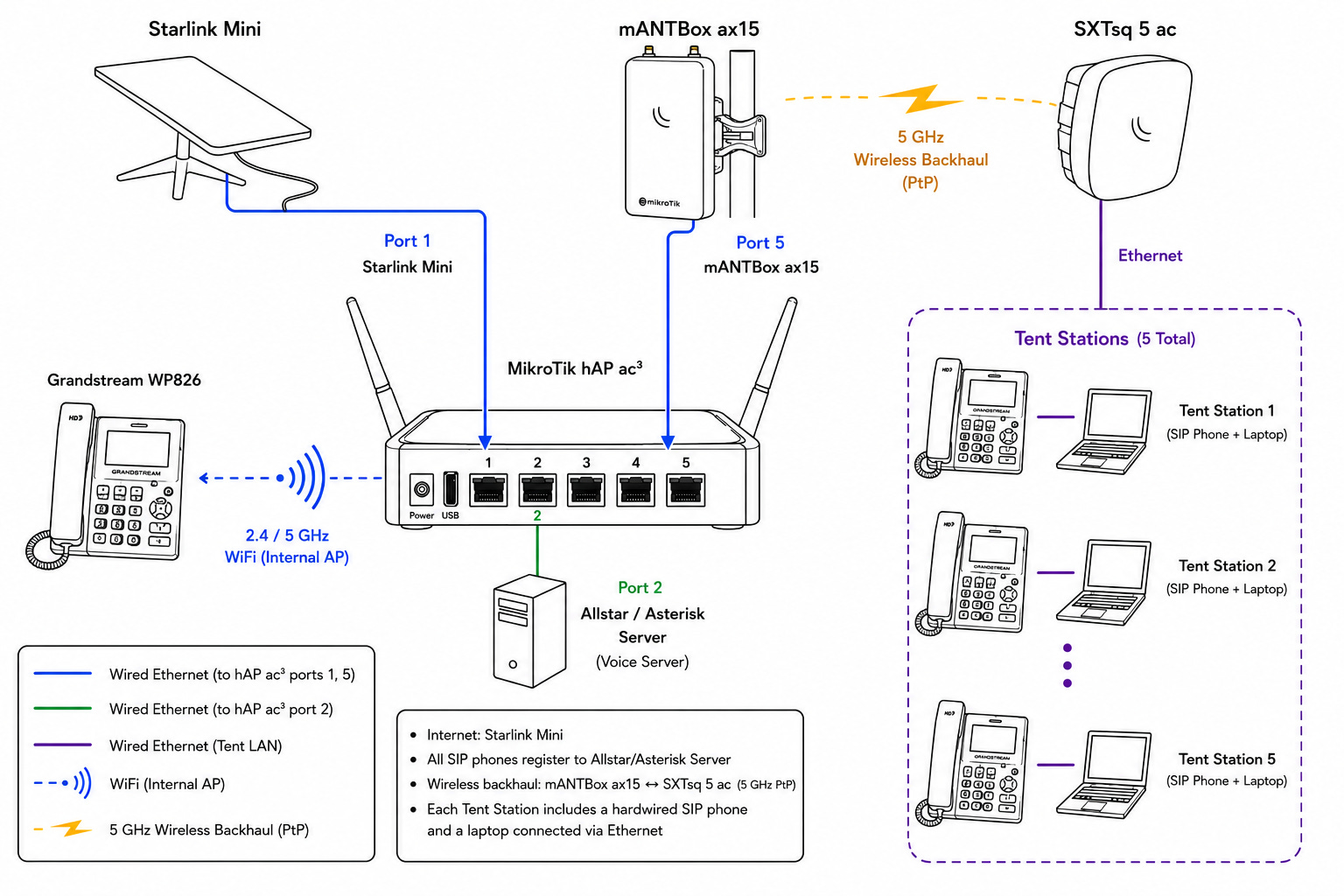
Tent-to-tent communication is also something that has been lacking in years past. N1MM+ has a chat service built in, and I set up a portable PBX using Asterisk and Allstar. The tents will have SIP phone extensions that can call each other, call out to other Allstar nodes such as the club repeater, and even get dialtone if they want that late night pizza delivery. This traffic will all be isolated on its own VLAN and separate SSID, so we shouldn’t have any issues with interlopers interloping.
In addition, I’ll set up another VLAN/SSID for the public to provide information about field day, our club and links about ham radio. This will probably be where the dashboard application lives too. It will run over Starlink so I will probably put some serious access controls on the VLAN to make sure we’re being good netizens and not burning up my monthly data allocation.
Finally I’ll have my own VLAN/SSID for my devices, because… well, I built the thing so why not? I’ll have both an HT and my WiFi SIP phone on my belt so tents can call me to help coordinate fixes to problems and vice versa.
Hardware
I’ve been working with MikroTik routers and switches for years (time flies). Their hardware isn’t necessarily the fastest for moving packets around, but it is pretty great for amateur use and still at a great price. I will be using the same hAP ac3 I installed in my camper van but with the addition of an external WiFi radio (MikroTik mANTBox ax 15s). This will be the access point for the tents. Each tent will have a MikroTik SXTsq 5 pointed back to the access point, and supplying Ethernet to the laptop and a SIP radio. These will be powered by a small DC UPS that will keep the connections up while refueling. The primary router and other network gear will be stationed at my camper van and should run on my Ecoflow Delta Max the whole time -and if not I’ll have the Ecoflow Smart Generator available too.
Overkill? Probably. But also gives me a chance to stretch my networking skills. Not only that but I’m now pretty familiar with MikroTik’s RouterOS operating system, which is widely used in ham radio for repeater linking, point-to-point networking and other general use. They aren’t the fastest routers out there, but they’re extremely capable and at a price point that’s extremely ham friendly. Normally the hAP ac 3 can also use my iPhone tethered to its USB port for a backup but T-Mobile service at the Field Day site is pretty much nonexistent.
Network Topology
I’m building in three separate VLANs. First will be my normal VLAN that has access to everything. This way I’ll be able to monitor and troubleshoot any issues that may come up. This is also where the Allstar/Asterisk/dashboard server lives, and it will have full access to the Starlink feed. It is basically unchanged from my normal set up, using the hAP ac3 integrated WiFi and switch. The second VLAN will be the tent network as described above. And the third subnet will be for the public to get information about Field Day, the Ski Country ARC and some of the nuts and bolts of the site. I will probably include limited Internet access to a few websites like APRS.fi and the ARRL.
N1MM+ Network
The N1MM+ operating manual has a pretty good explanation of how to set up multiple computers on a network. I did some testing with a few old Windows PCs I have at home and have a few tips. First, it is important that the names of each machine are identifiable. By Default Windows 11 uses generic names like “Desktop-NLC19EM,” which means it will absolutely get confusing when troubleshooting. For our site, I’m recommending the computer name needs to match the tent, so VOICE-TENT, CW-TENT, DIGITAL-TENT, etc. That will become important when checking network status and for sending messages between tents. I’ll probably have to set up a sixth “tent” for the scoreboard app. N1MM+ computers all keep their own copy of the log, which adds some redundancy, but it also means they need to remain in sync. If one goes offline then it has to be manually resynchronized with the rest of the logs. The other change for this year is requiring all stations to connect their radios directly to their logging PCs. That gives us more accurate logs. Even though band and frequency information aren’t strictly required for Field Day, it’s still good operating practice. And operators can use the band map window to see stations worked and their approximate frequency to help avoid duplicate contacts.
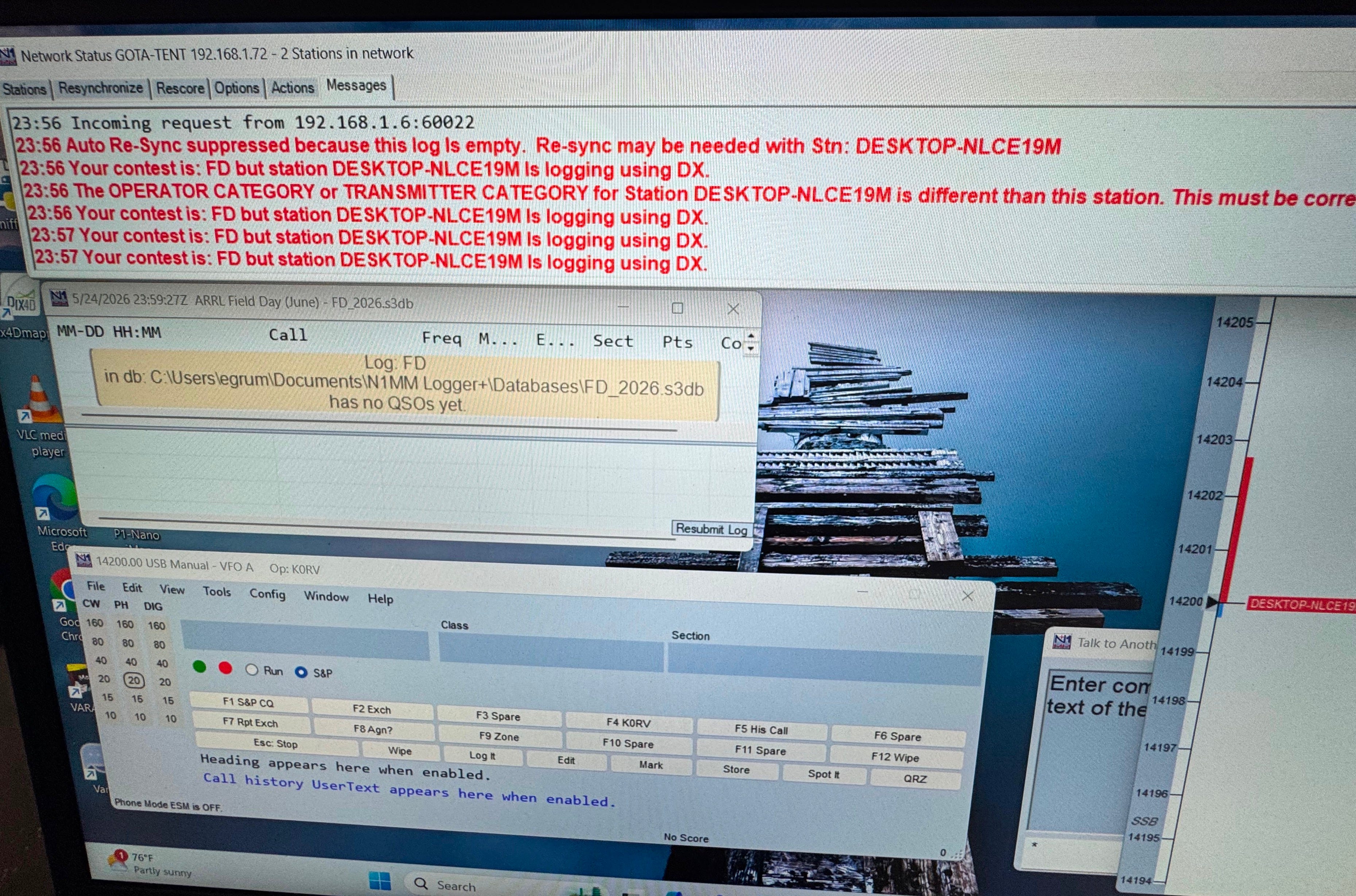
When all the PCs are talking the logs are all updated almost immediately (it’s just a few lines of text) so everyone operating will see the score in realtime. For the rest of us I’ll have a scoreboard app running. As of the time of writing this I haven’t really done much other than have a conversation with ChatGPT over how it will work, but there is at least one app already built and I’ll borrow heavily from that. Depending on how it turns out I’ll likely put up a new post with the details.
The Hard Part Isn’t the Hardware
Configuring hardware and making up Ethernet cables is the easy part. Setting up software can be a little confusing but at least we can try it out before going live. Our club has been doing field day since the 1970s. Some of the founding members are still with us, and their experience means the site comes together fairly quickly. That’s not saying that it’s not without changes, just that there’s a lot of detail that’s not covered in the safety briefing. Not only that but little details like scheduling operators, standard operating procedures and who does what has become rote and usually only a few members maintain that knowledge. We need to document and inventory all the club’s equipment, identify who will be supplying what and make sure it’s pre-configured and tested before coming on site. That’s real work and usually an afterthought, but I think it is one of those often overlooked necessities.
The truly hard part might be getting people to understand and use the network. Many of our club members have been doing Field Day longer than I’ve been alive. To say they’re going through the motions is an understatement. I’m certain some will question the need for all this extra stuff, especially the pencil and paper guys. I get it, often times the simple solution is the best, but now that I’m in charge of reporting our score to the ARRL I don’t want to spend a lot of time attempting to read chicken scratch. And there’s the constant lament about the lack of new people coming into the hobby. Maybe it will generate some interest — or at least demonstrate what amateur radio operators can still accomplish when we combine old skills with modern tools.
Even though the mantra is “Field Day is not a contest” we do all keep score and the results are listed in the December QST. The main difference between FD and a normal contest is that there aren’t any awards sent out for winning.